Liquidation risk
This page describes liquidation in the context of the Aave v4 integration — the first supported DeFi use case for TBV on the public testnet.
Liquidation is what happens when your debt outgrows the value of your collateral. This page is written from the depositor's side: when it triggers, what gets seized, what you keep, and how to avoid it.
When liquidation can happen
A position becomes liquidatable when the health factor drops below 1.0. The health factor compares the risk-adjusted value of your collateral to the value of your debt:
Health Factor = (Total Collateral Value × Collateral Factor) / Total Debt Value
On the current Testnet, the collateral factor for BTC collateral is 78%. Two things move the health factor:
- BTC price drops. Your BTC collateral loses value in USD terms while debt stays denominated in the borrowed token.
- Interest accrues. Your debt grows continuously under the Aave v4 interest rate model.
Once the health factor crosses below 1.0, liquidation becomes available. In practice, professional liquidator bots compete for these events; once a position falls below 1.0, a liquidation typically clears within the next block or two.
Why a BTC vault is indivisible
A BTC vault is a single Bitcoin UTXO. It can be claimed in full or not at all; the protocol cannot seize half of a vault. This is structural, not a design choice: Bitcoin transactions can only spend whole outputs.
This is why liquidation behaves differently here than on a typical Aave market. The mechanism walks a list of whole vaults and decides which ones to seize as a group, rather than scaling a single collateral pool by a fraction.
How liquidation works in TBV
On a standard Ethereum market, liquidation is both atomic and permissionless:
- Atomic. In a single transaction, the liquidator repays the debt and receives the collateral. There is no gap between the two.
- Permissionless. Anyone can liquidate, so a competitive market of liquidator bots closes a position the moment it crosses 1.0, before its collateral can fall below the debt it backs.
This cannot work directly when the collateral is BTC on the Bitcoin Network and the market is on Ethereum. Releasing a vault's BTC runs through the redemption flow on Bitcoin — claim, challenge window, payout — which takes days and cannot settle inside a single Ethereum transaction. The standard "repay now, take the collateral now" loop is impossible across the two chains.
A Liquidation Liquidity Provider (LLP) closes this gap. The LLP supplies instant settlement liquidity on Ethereum, so liquidation stays atomic there while the slower BTC redemption happens in the background. At liquidation, the liquidator is paid immediately from the LLP in WBTC, the seized vault is escrowed in the LLP, and a registered Arbitrageur later acquires that vault and finalizes the redemption on Bitcoin.
Two liquidation paths exist once a position becomes liquidatable:
- Permissionless (LLP-routed). The liquidator repays the debt and is settled instantly in a fungible wrapped-BTC asset, WBTC at launch, drawn from the LLP plus the liquidation bonus. The seized vault enters LLP escrow. The first LLP is the BTCVault Swap Spoke (the
BTCVaultSwapcontract), registered as its own WBTC spoke on the Aave v4 Hub. - Permissioned (direct redemption). Restricted to registered Arbitrageurs, also called App Keepers, that took part in the vault's creation and hold its Bitcoin redeem key. They repay the debt and take the seized vault directly into the BTC redemption flow themselves, without drawing on LLP liquidity.
What "liquidation" actually seizes
Two terms describe distinct things, and they apply at the same time:
- Full-vault liquidation. Each individual vault is seized whole. When a vault is seized, the whole vault moves.
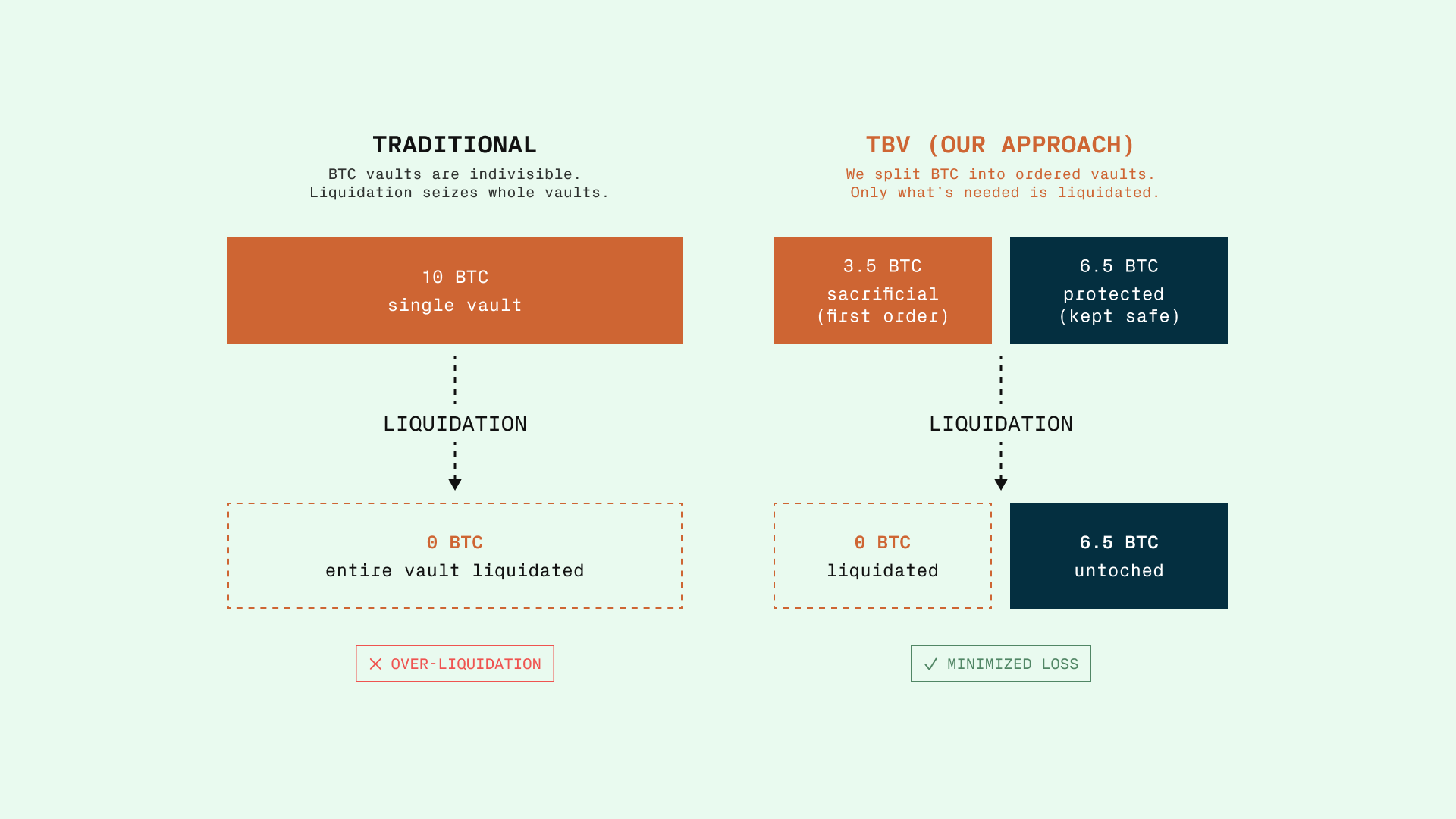
- Partial-position liquidation. When your position contains multiple vaults, the protocol seizes only the subset of vaults needed to restore the health factor to its target. The rest stay in your position.
The protocol walks your vault list in order during liquidation and takes consecutive vaults from the front until their cumulative value covers the protocol's target seizure amount. The target seizure depends on the target health factor (THF) and your collateral and debt sizes.
If your position contains a single vault, partial-position is not possible: that one vault is your entire collateral, and seizing it discharges the whole position in one event. This is the cliff effect: a single small price move can take everything backing the position.
The two-vault mitigation
The portal recommends splitting your BTC into two vaults at peg-in: a sacrificial vault (sized to cover the protocol's expected seizure amount, placed first in the liquidation order) and a protected vault (whatever BTC remains, placed second).
The sacrificial vault's size depends on the target health factor (THF) and other protocol parameters. The portal computes the recommended split dynamically from the on-chain values.
A worked example
Suppose you peg in the public-testnet maximum and split it as recommended. With THF = 1.24, CF = 78%, max LB = 10%, and a typical worst-case health factor at liquidation of ~0.97:
- Target seizure: ~62.5% of total BTC
- Sacrificial vault: target seizure, placed first
- Protected vault: remaining BTC, placed second
If the position becomes liquidatable, the protocol walks your vaults in order. The sacrificial vault alone covers the target seizure, so only that one vault is seized. The protected vault stays in your position.
Without the split, the same liquidation seizes the full single vault. That is the cliff effect.
You can reorder vaults after creation. If price action changes which vault is the right sacrificial buffer, reorder it before the position becomes unhealthy. See Create a vault for the two-vault setup at peg-in.
Fairness payment
Because vaults are indivisible, the seized vault almost always carries slightly more BTC than a perfectly divisible partial liquidation would have taken. The fairness mechanism returns the excess to you.
The protocol computes the over-seizure surplus and applies one of two compensations, depending on whether you have remaining debt after the liquidation:
- Fairness debt repayment — if the surplus is smaller than your remaining debt, the surplus reduces your remaining debt. No WBTC is paid out; the debt position simply shrinks.
- Fairness payment — if the surplus exceeds your remaining debt (or your debt is fully repaid by the seizure), the leftover surplus is paid to you in WBTC.
The fairness payment is denominated in WBTC rather than native BTC because the protocol cannot conjure new BTC mid-liquidation. WBTC is the closest BTC-pegged asset available on Ethereum and trades very close to BTC parity.
What the liquidator earns
The protocol pays the liquidator a liquidation bonus: collateral worth more than the debt repaid. From the depositor's side, the bonus is what the protocol pays out of the collateral to compensate the liquidator. The fairness payment then returns any leftover to the depositor.
Health factor zones
| Health factor | What it means | What to do |
|---|---|---|
| Above 1.5 | Comfortable margin | Monitor during BTC volatility |
| 1.2 to 1.5 | Approaching risk | Consider repaying some debt or adding collateral |
| 1.0 to 1.2 | High risk | Repay or add collateral immediately |
| Below 1.0 | Liquidatable | Position can be liquidated at any moment |
The zones above 1.0 are guidance, not contract values. The only on-chain threshold is the 1.0 boundary.
How to avoid liquidation
- Borrow conservatively. Stay well below the maximum your collateral allows. A health factor above 1.5 leaves headroom for normal BTC volatility.
- Use the two-vault split. It is the most effective protection against the cliff effect, and the portal recommends it by default at peg-in. The portal also sizes the split for current parameters; don't manually undersize the sacrificial vault.
- Trust the portal's ordering. The recommended order (sacrificial first) is what the protocol walks during liquidation. Reordering matters; review your order when parameters change.
- Repay early when the health factor declines. Partial repayments restore the health factor without closing the position. See Borrow & repay.
- Add collateral. Add more vaults to the position. Each added vault raises collateral value and the health factor; reorder afterwards if needed.